


Author Spotlight: Jonathan Horn

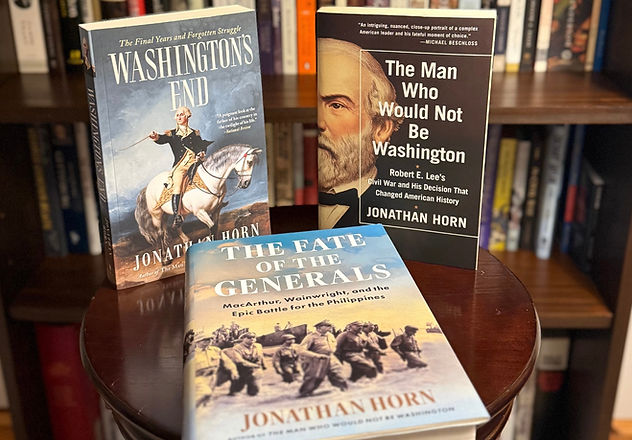
Author Jonathan Horn has written some terrific works of history. In honor of Horn’s birthday this week, here are a few thoughts on the great volumes he has produced so far.
After almost two decades of uninterrupted service to his country during the Revolutionary War, at the Constitutional Convention, and as America’s first president, George Washington was ready to spend his final days in ease at his beloved home of Mount Vernon in Virginia. As much as he looked forward to his retirement from public life, though, Washington’s thoughts never strayed far from the well being of the country that he had fought so hard to establish. Between the prospects of a potential war with France, deep political tensions reverberating across the country, and other dark portents, instead of a well-earned peace, Washington’s final years were filled with a great amount of anxiety as he worried over America’s future. Jonathan Horn walks us through this closing chapter in the life of America’s greatest hero in Washington's End: The Final Years and Forgotten Struggle.
When the American Civil War broke out in the spring of 1861, the stars seemed to align for Robert E. Lee to follow in the footsteps of his hero of history, George Washington. Lee had a deep connection to Washington. His father, “Light-Horse” Harry Lee, had served under him during the Revolutionary War. Robert E. Lee had also married Mary Anna Randolph Custis, the daughter of Washington’s step-grandson and adopted son, George Washington Parke Custis. Lee’s home, Arlington House, which sat across the Potomac River from the national capital, was inherited from his father-in-law and was essentially a memorial to George Washington, containing many of Washington’s possessions, including everything from historic paintings to the bed he died in. Despite his reverence for Washington, his three decades of service in the U.S. Army, and his opposition to secession, when offered command of the Federal forces being raised to put down the Southern rebellion, Robert E. Lee declined. Following the lead of his native state of Virginia after it had seceded from the Union, he ultimately resigned from the U.S. Army and later accepted a general’s commission in the newly formed Confederate army. Lee’s decision to choose his home state over the American Union forged by George Washington was not one that he made lightly. As he wrote to his sister, “With all my devotion to the Union and the feeling of loyalty and duty of an American citizen, I have not been able to make up my mind to raise my hand against my relatives, my children, my home.” The story of Lee, his connection to Washington, and his fateful choice that put him in such opposition to Washington’s legacy of building and safeguarding the Union, is supremely well told by Jonathan Horn in The Man Who Would Not be Washington: Robert E. Lee’s Civil War and His Decision That Changed American History.
Horn’s latest book, The Fate of the Generals: MacArthur, Wainwright, and the Epic Battle for the Philippines, was released in April 2025 and eagerly sits in my library waiting to be read.


Comments