


Standing Tall: The Trials of General George Washington During the Siege of Boston

Updated: Apr 3
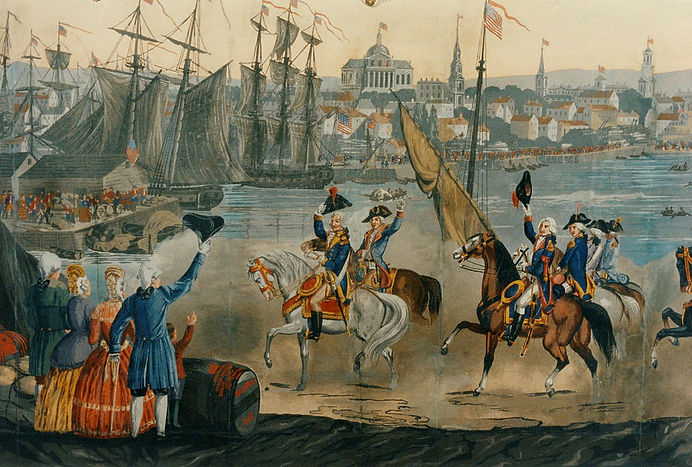
After nearly a year filled with some of the most stressful, mentally-exhausting days of his life, a victorious General George Washington finally entered a liberated Boston, Massachusetts on March 18, 1776. One day earlier, nearly 11,000 British troops and around 1,100 Loyalist civilians had crammed into over 120 ships, evacuating Boston and bringing an end to a 332-day siege of the embattled harbor town. It was a major moment of triumph for Bostonians and supporters of the American cause, marking the first major victory of the Revolutionary War for General Washington and the soldiers of his Continental Army. In a special address to Washington, the Selectmen of Boston thanked and congratulated “Your Excellency on the success of your military operations, in the recovery of this town,” adding that, “You have not only saved a large, elegant, and once populous city from total destruction, but relieved the few wretched inhabitants from all the horrors of a besieged town, from the insults and abuses of a disgraced and chagrined army, and restored many inhabitants to their quiet [homes] who had fled, for safety, to the [heart] of their country.”1
George Washington’s victory at Boston did not come easily. From the moment he had arrived to take command of the colonial forces besieging the British in Boston on July 3, 1775, the challenges that confronted him were daunting. As Washington later wrote when reflecting on the trials he endured during the long siege, “I believe I may, with great truth, affirm that no man, perhaps since the first institution of armies, ever commanded one under more difficult circumstances than I have done.”2 By examining some of those “difficult circumstances,” we gain a better appreciation of what Washington faced and ultimately overcame en route to victory.
Building an Army from the Ground Up
George Washington’s first task as commander in chief was to mold a disorganized collection of colonial militias into a cohesive professional fighting force, teaching his men the fundamentals of soldiering. As historian David McCullough described the forces Washington inherited, “It was the first American army and an army of everyone, men of every shape and size and makeup, different colors, different nationalities, different ways of talking, and all degrees of physical condition.”3 Some of those soldiers were mere boys of 15 years old or less. Lacking formal uniforms, most of the troops wore tattered clothing ranging from heavy homespun coats to shirts and whatever other articles of clothing they had. As a whole, they were unaccustomed to the rigors of professional military life. Important policies for maintaining the health of an army such as digging proper latrines were foreign to them. As a result, their camps were exceedingly dirty and the smells that emanated from them were anything but pleasant. It was up to Washington to clean everything up, to instill order and discipline, and to transform these men that the British dismissed as “ragamuffins” and a “rabble in arms” into true soldiers.4
A Master Multitasker
The ability to juggle multiple tasks and responsibilities at once was critical for General Washington during the siege of Boston. He could not merely focus on turning his band of citizen-soldiers into a force capable of going toe to toe with an enemy that belonged to the mightiest war-machine in the world. As commander in chief, Washington also had to keep the larger picture in view, overseeing every aspect of his army and never losing sight of his ultimate goal of capturing Boston from the British. Whether designing and implementing a new system of uniforms, issuing orders for latrines to be dug and kitchens to be swept, organizing troops into coherent fighting units, and so much more, Washington did it all. Day after day, he would ride his lines and tackle a new set of problems, never losing sight of the enemy in Boston that was barely a mile away.
Problems of Supply
At the end of his first month in command, George Washington fell silent when he learned that there was only enough gunpowder in the army’s stores for nine rounds per man. Meanwhile, British soldiers in Boston had plenty of firepower of their own, carrying 60 rounds per man. This is one of the many examples of how shortages of critical supplies like gunpowder made Washington’s job of capturing a heavily fortified town from a strongly-armed enemy so difficult. The commander in chief was forced to spend significant time and energy putting systems in place and seeking solutions to provide his soldiers with the materials that they needed to fight and survive.
Stalemate
Despite the challenges that his army operated under, George Washington still maintained an aggressive edge. On three occasions, the commander in chief held councils of war with his generals to propose an all-out attack on Boston. If the town and the British army within it could be captured, Washington hoped to win a decisive victory that might shorten or possibly bring the war to an end. At each of those councils of war, however, Washington’s generals voted against launching an attack. From the raw condition of the troops to the army’s supply problems, they had many concerns about the feasibility of an offensive, especially since the British position was so strong. It was true that the British were confined to Boston, but they had strongly fortified the town and had control of the sea, which was their lifeline for supplies and reinforcements. The cannon on British warships anchored in the harbor and on floating batteries were also deadly elements that menaced the Americans at all times. With the British hesitant to attack the American siege lines surrounding Boston and the Americans lacking the strength and firepower necessary to take the town, an uneasy stalemate settled between the opposing armies.
Standing Tall in the face of Adversity
The American position became extremely vulnerable as the year 1775 drew to a close. Around this time, due to short-term enlistments, General Washington was forced to disband one army and recruit another in the face the enemy. Washington’s lines were so thin at the start of 1776, and the stresses on his shoulders were so intense, that he despairingly wrote, “I have often thought how much happier I should have been if, instead of accepting . . . a command under such circumstances, I had taken my musket upon my shoulder and entered the ranks; or, if I could have justified the measure to posterity and my own conscience, had retired to the back country. . . .”5 Despite his intense gloom and frustration, Washington continued to stand tall in the face of adversity. It was one of his greatest attributes as commander in chief; he simply refused to give up, no matter how bad circumstances looked. As he had written to a fellow general earlier that summer, “Perseverance and spirit have done wonders in all ages.”6 Those were the words that he lived by, and his fortitude ultimately paid off.
The “Noble train of Artillery”
The prospects for General Washington and his army finally brightened when Colonel Henry Knox and his “Noble train of Artillery” reached the American siege lines outside of Boston in late January 1776.7 Earlier that fall, Washington had entrusted the 25-year-old Knox to lead a party to Fort Ticonderoga in upstate New York, where a valuable treasure trove of captured enemy artillery awaited. Knox made the journey and selected 59 of the best guns, a total lot weighing nearly 120,000 pounds. Using sleds and wagons pulled by teams of horses and oxen to move the heavy guns across deep, snowy trails, icy rivers, and rugged mountain passes, Knox and his men ultimately traveled 300 miles in the dead of winter to bring the desperately needed artillery back to Boston. Through the perseverance of Knox and his men, General Washington and his army finally got the firepower that was needed to break the stalemate that had developed during the siege of Boston. Once those guns were placed on Dorchester Heights, a commanding ridge south of Boston that overlooked the town and its harbor, the British were ultimately compelled to evacuate on March 17, 1776, giving Washington and the Americans their first major victory of the Revolutionary War.
The Long Road Ahead
George Washington was crowned with laurels for guiding his army to victory at Boston. Harvard College awarded him an honorary degree and the Continental Congress ordered a gold medal struck in his honor. Optimism was in the air and spirits were high. As Washington knew, though, the fight against the British was far from over. The next chapter of the war would bring the commander in chief and his men even greater difficulties than they had faced at Boston. As time would show, 1776 was destined to be the year that would “try men’s souls.”
Notes:
1. "Address from the Boston Selectmen, March 1776," Founders Online, National Archives.
2. "George Washington to John Augustine Washington, 31 March 1776," Founders Online, National Archives.
3. David McCullough, 1776 (Simon & Schuster, 2005), 34.
4. McCullough, 32.
5. "George Washington to Lieutenant Colonel Joseph Reed, 14 January 1776," Founders Online, National Archives.
6. "George Washington to Major General Philip Schuyler, 20 August 1775," Founders Online, National Archives.
7. "Colonel Henry Knox to George Washington, 17 December 1775," Founders Online, National Archives.
Bibliography:
Archino, Joe. “To Banish the British: George Washington and the Siege of Boston.” This Is Why We Stand, www.thisiswhywestand.net/single-post/to-banish-the-british-george-washington-and-the-siege-of-boston.
“The Evacuation of Boston, 1776 (U.S. National Park Service).” National Parks Service, U.S. Department of the Interior, www.nps.gov/articles/000/evacuation-of-boston-1776.
McCullough, David. 1776. Simon & Schuster, 2005.
Rhodehamel, John. George Washington the Wonder of the Age. Yale University Press, 2020.
“Trials in Command: George Washington’s Difficulties during the Siege of Boston (U.S. National Park Service).” National Parks Service, U.S. Department of the Interior, www.nps.gov/articles/000/trials-in-command-gw-siege-of-boston.


Comments